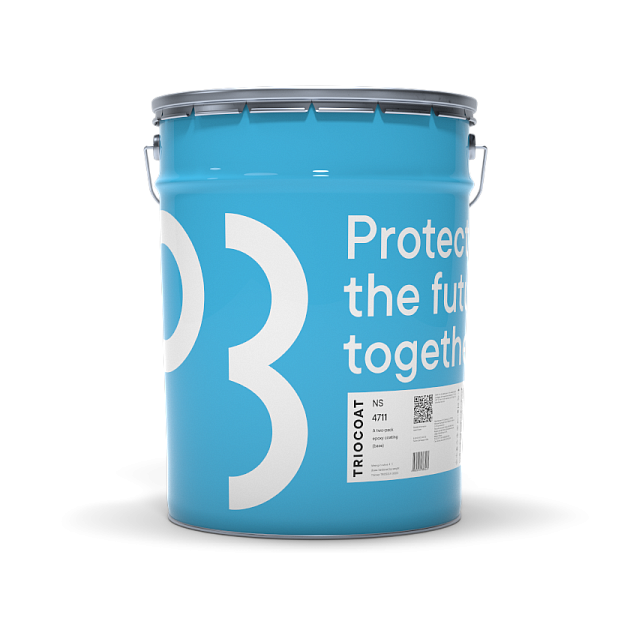
TRIOCOAT HS 4711 — Application Manual
Epoxy coating. Product description: see Technical Data Sheet for TRIOCOAT HS 4711.
CONTENTS
The instruction provides guidance on surface preparation; material preparation for application; the application process and equipment used; storage conditions; safety precautions; fire safety measures; environmental protection; first aid measures.
SURFACE PREPARATION
The material is applied to a prepared and dry surface with a temperature at least 3 °C above the dew point. The preparation process includes the following operations:
- elimination of surface defects to P3 according to ISO 8501-3;
- degreasing of the surface (if necessary);
- surface cleaning:
- carbon steel — to grade Sa 2.5 according to GOST R ISO 8501-1;
- stainless steel — abrasive blast cleaning with a non-metallic abrasive, sharp profile;
- aluminium — abrasive blast cleaning with a non-metallic abrasive, sharp profile;
- galvanized steel — light abrasive blast cleaning with a non-metallic abrasive to a clean roughened surface;
- steel with shop primer — sweep;
- painted surface — compatible coating without defects;
- concrete — polymerization duration at least 4 weeks, moisture content not more than 5 %, closed abrasive jet or grinding, complete removal of cement laitance.
Recommended roughness profile 50–75 µm.
During repair, local cleaning P St 3 is allowed and desalting of the surface (if necessary). Dust removal of the surface to degree 2 with a particle size of not more than class 2 according to ISO 8502-3.
The interval between surface preparation and material application is determined by environmental conditions and the characteristics of the materials used in accordance with the manufacturer's recommendations.
Do not apply the material if the overcoating interval of the previous coat of material is exceeded in accordance with the recommendations of the manufacturer of the applied material. If the overcoating interval is exceeded, then to ensure intercoat adhesion of the anti-corrosion coating to the previous coat material, the surface must be roughened by sweeping (light abrasive blast cleaning, carried out at an angle of 30° to the surface to be cleaned and a pressure of ½ of the working pressure) before applying the anti-corrosion material.
MATERIAL PREPARATION
TRIOCOAT HS 4711 is a two-component epoxy coating with polyamide curing and high molecular weight, with volume solids 65±5 %, thinner TRIOSOLV 0002 is used.
The material is supplied in euro pails: base — 20 l, hardener — 5 l.
After opening the container, before application, the base and the hardener must be mixed separately. Mixing is carried out in a ratio of 4 : 1 (base : hardener) by volume, with thorough stirring to a homogeneous mass.
APPLICATION
Application method:Airless spraying / Pneumatic spraying / Manual application
Thinner:Thinner TRIOSOLV 0002 (if necessary), up to 5 % by volume for airless spraying, up to 12 % by volume for pneumatic spraying. For more detailed information, contact O3-Coatings.
Nozzle diameter (recommended):Airless spraying — .015"–.019"; pneumatic spraying — (1.7–2.0) mm
Operating pressure (recommended):Airless spraying — not less than 150 bar; pneumatic spraying — (1.7–2.0) bar
Equipment cleaning:Thinner TRIOSOLV 0002 (other solvents may be used in agreement with O3-Coatings)
Recommended application conditions
- air temperature not lower than minus 10 °C;
- relative air humidity not higher than 85 %;
- temperature of the surface to be painted at least 3 °C above the dew point;
- absence of direct atmospheric precipitation.
IMPORTANT: Work is prohibited if the above parameters do not meet the requirements.
Control parameters before shift
Before the start of each work shift, it is recommended to check and record the following parameters:
- environmental conditions (air temperature, relative humidity);
- dew point temperature;
- surface temperature;
- absence of moisture and oil contamination on the surface;
- absence of dust on the surface.
Equipment preparation
Before applying the material, pass a solvent through the spray equipment to clean it from previously used paints and coatings. The solvent depends directly on the type of materials used earlier. Equipment cleaning is also recommended at the end of the work shift.
The material should be applied by airless spraying; application with a brush or roller is allowed in hard-to-reach places or on small surfaces.
When applied by airless spraying, the recommended wet film thickness (WFT) per pass is (120–150) µm, which corresponds to a dry film thickness (DFT) of (80–100) µm.
DRYING TIME
Table 1 — Drying time at DFT (85–90) µm
Drying time is determined by the actual DFT. The drying times given in this section are for guidance only. When assessing the actual drying time, it is also necessary to take into account the presence of air flows and relative air humidity.
WET FILM THICKNESS CONTROL
Wet film thickness is controlled with a "comb" gauge using the last tooth touching the paint. Above each tooth of the comb, its gap value in microns from the "base" teeth (from 0) is marked.
When performing measurements, the comb must be installed perpendicular to the plane of the painted surface. After each measurement, the surface of the comb in contact with the paint must be thoroughly wiped with a clean cloth.
The wet film thickness of the coating must be recorded.
QUALITY CONTROL OF THE FINISHED COATING
Quality control of the finished coating is performed according to the following characteristics:
- appearance (no sags, cracking, peeling, etc.) — a uniform grey coating;
- dry film thickness is determined by the 80–20 rule: 80 % of the measured thicknesses must be not less than the thickness specified in the specification (nominal thickness); 20 % of the measured thicknesses must be not less than 80 % of the nominal thickness.
IMPORTANT: Do not apply the next coat until the required coating thickness is achieved.
To measure the dry film thickness of coatings, it is recommended to use thickness gauges with a measuring range from 0 to 5000 µm.
STORAGE
It is recommended to store the epoxy coating TRIOCOAT HS 4711 in a well-ventilated dry room at a temperature from 0 to plus 30 °C in sealed factory packaging, indoors, avoiding direct exposure to UV rays.
The shelf life of TRIOCOAT HS 4711 is 48 months for the base and 24 months for the hardener subject to storage conditions. The material should be used within the shelf life recommended by the manufacturer. The decision on the use of material with a shelf life of more than 48 months for the base and more than 24 months for the hardener is taken by a commission.
SAFETY PRECAUTIONS
General provisions
During work, the requirements of GOST 12.3.002, GOST 12.3.005, GOST R 12.3.052 must be observed. Hazardous and harmful production factors must be eliminated or reduced to acceptable levels. When organizing and performing painting work, physiologically justified work and rest regimes should be provided.
Personnel requirements
Persons not younger than 18 years of age who have completed the following are allowed to perform anti-corrosion works:
- occupational safety training — according to Decree of the Government of the Russian Federation No. 2464 of 24 December 2021, industrial sanitation, fire and electrical safety;
- vocational training.
Officials, in accordance with the requirements of SNiP 12-03 and SNiP 12-04, are responsible for compliance with labour protection and industrial safety requirements during work.
Workers must know:
- hazardous and harmful production factors, harmful substances in the composition of the materials used in the air of the working zone and the nature of their effect on the human body;
- instructions on the procedure for performing work and maintaining the workplace;
- instructions on labour protection, fire safety, industrial sanitation;
- personal hygiene rules;
- rules for the use of personal protective equipment (PPE);
- rules for providing first aid.
Safety requirements for surface preparation and painting
All work related to the use of paints and coatings in rooms must be carried out with operating general supply-and-exhaust and local exhaust ventilation according to GOST 12.4.021. Ventilation must ensure that the content of harmful substances in the air of the working zone does not exceed the maximum permissible concentrations in accordance with the requirements of GOST 12.1.005, SanPiN 1.2.3685.
Workers engaged in surface degreasing, preparation and application of paints and coatings must be provided with the following PPE:
- protective painting suits, disposable or reusable, with a zipper running along the length of the garment for ease of putting on and taking off, elastic bands at the wrists, ankles and waist, and a hood;
- technical rubber gloves according to GOST 20010;
- safety glasses according to GOST 12.4.253, symbol 3, or equivalent with the same functional purpose;
- filtering respirators with an insulating face piece in the form of a half-mask according to GOST 12.4.296 with a combined RPE filter providing simultaneous protection against gases, vapours and aerosols according to GOST 12.4.235 AZRZ (brown-white), AKhRZ or equivalent with the same functional purpose;
- footwear made of leather, with a hard toe to avoid injury to the feet in case of falling heavy objects; the sole is protected by a metal plate.
IMPORTANT: Working without PPE is PROHIBITED!
Storage of organic solvents at the workplace is allowed in hermetically sealed containers in an amount not exceeding the two-shift norm.
When working with solvents, observe the following safety requirements: use respiratory and eye PPE; work with the ventilation system turned on, providing air exchange at the required rate.
During surface preparation, the sandblaster must work in special clothing made of dust-proof fabric and a helmet of the MIOT-49 type, and use PRB-5 respirators with forced air supply.
Rules for handling toxic substances
The epoxy coating TRIOCOAT HS 4711 is manufactured in accordance with TU 20.30.12-310-40141638-2025 and is recommended for anti-corrosion protection of various engineering structures, facilities, building structures for residential, civil and industrial purposes.
The container in which the epoxy coating TRIOCOAT HS 4711 is located must have a label with the exact name and designation of the material contained in it. The container must be intact and have a tightly closing lid.
In case of accidental spillage of paint, cover the spill area with sawdust or sand, having previously protected the respiratory organs. Contaminated solvents, sawdust, sand, rags, cloths should be collected in buckets and removed to specially designated places in accordance with the requirements of GOST 30772, GOST 30773, GOST 30774, GOST R 52107.
Eating and smoking is allowed only in specially designated places.
FIRE SAFETY MEASURES
Fire safety measures during painting work must be carried out in accordance with the Technical Regulation on Fire Safety Requirements (No. 123-FZ of 22 July 2008) and other regulatory documents.
The paints and coatings used are classified as flammable materials; therefore, fire safety measures are taken at the workplace in accordance with the requirements of GOST 12.1.004 and Decree of the Government of the Russian Federation No. 1479 of 16.09.2020 "On Approval of the Fire Regime Rules in the Russian Federation".
IMPORTANT: The use of water to extinguish a fire is prohibited.
When performing surface preparation for painting and painting works, it is not allowed to:
- smoke, light fires, or carry out welding works within a radius of 25 m from the work site, as well as along the entire vertical in this zone;
- heat production rooms and protected objects with electrical appliances of standard design.
In the event of a fire, people should be evacuated from the danger zone, the fire service should be notified, paints and coatings should be removed from the work zone, and fire extinguishing should be started with the available means in strict accordance with the approved plan.
ENVIRONMENTAL PROTECTION
During painting work, solid and liquid wastes are generated.
Table 2 — Waste and disposal methods
FIRST AID MEASURES
General: if poisoning is suspected, seek medical help.
In case of inhalation: if the product is inhaled, move the victim to fresh air, ensure rest and seek medical help.
In case of contact with eyes: if the product gets into the eyes, rinse them with plenty of clean running water and seek medical help.
In case of contact with skin: if the product gets on the skin, remove contaminated clothing and wash the contact area thoroughly with soap and water. The use of solvents or thinners is prohibited.
In case of contact with food: if the product enters the body with food, ensure rest for the victim and immediately seek medical help.
IMPORTANT: Do not induce vomiting.