
- 1.5 h before overcoating
- 1К
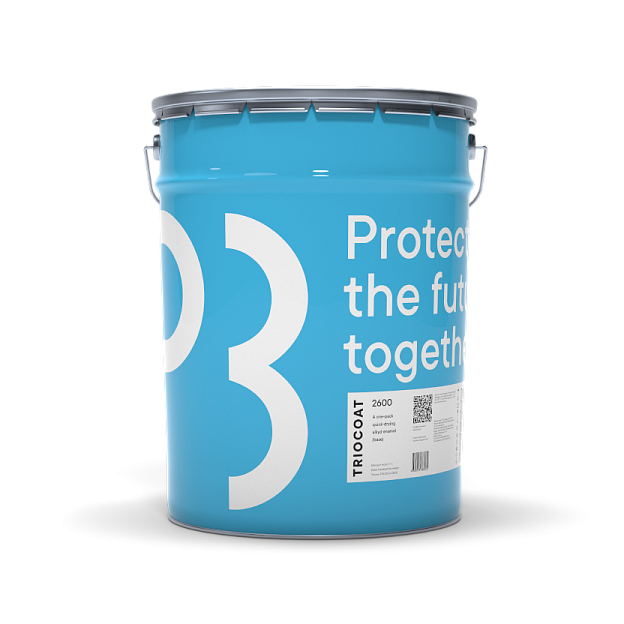
TRIOCOAT™ 2600
- Can be operated at high temperatures – up to 120°C.
- Can be applied at sub-zero temperatures – down to minus 10°C.
- Airless spraying/pneumatic spraying/manual application.
- Non-sagging WFT layer thickness: at least 250 μm
TRIOCOAT 2600 — Technical Data Sheet
Alkyd primer-enamel. One-component fast-drying anti-corrosion alkyd primer-enamel.
MATERIAL DESCRIPTION
One-component fast-drying anti-corrosion alkyd primer-enamel.
COATING PURPOSE
The primer-enamel is used for corrosion protection of external and internal surfaces of all types of freight railcars and undercar equipment of railway transport, bridges and other engineering structures, pipe racks, pipelines for various purposes, other structures of oil and gas facilities, metal structures in the construction of civil, public, industrial buildings and structures, vehicles, road and agricultural machinery, electrical equipment, crane equipment, containers (including MSW containers). Typical operation of the coating — in moderate, moderately cold and cold climates and atmospheric corrosivity from very low C1 to high C4 (GOST 34667.2 (ISO 12944-2)). The primer-enamel is tolerant to surface preparation (preparation grades Sa 2, St 2 are allowed). It can be used as a repair material and is compatible with most types of old paint and coating systems. The operating temperature of the coating is from minus 60 to plus 40 °C.
PHYSICAL CHARACTERISTICS
Coating thickness:
| Film thickness | WFT, µm | DFT, µm |
|---|---|---|
| Minimum | 89 | 40 |
| Maximum | 267 | 120 |
| Recommended | 134 | 60 |
Drying time:
| Drying time at DFT 60 µm | |||||
|---|---|---|---|---|---|
| Ambient temperature | 0 °C | 5 °C | 10 °C | 20 °C | 30 °C |
| Drying to overcoating with the next coat | 9 h | 6 h | 3 h | 1.5 h | 30 min |
The maximum overcoating interval is unlimited.
The drying time of the coating at a temperature of plus (20±2) °C to the possibility of transportation is not less than 12 h.
The full curing time of the coating at a temperature of plus (20±2) °C is not less than 5 days.
Drying time is determined by the actual applied layer thickness. The drying time values given in this section are for guidance only. When assessing the actual drying time values, it is also necessary to take into account the presence of air flows and relative air humidity.
SURFACE PREPARATION
The material is applied to a previously prepared surface.
- Steel surface: the surface to be painted must be dry, clean and uniform with a temperature at least 3 °C above the dew point. A typical surface preparation scheme includes elimination of metal surface defects to grade P2 according to ISO 8501-3 (sharp edges and corners are to be rounded with a radius of at least 2 mm), abrasive blast cleaning to grade Sa 2 according to ISO 8501-1 (local application of cleaning with hand or mechanical tools to grade St 2 is allowed), degreasing to grade 1 according to GOST 9.402, desalting (if necessary), roughness assessment (must correspond to the medium (G) profile according to ISO 8503-1), and dust removal with compressed air of group 2 according to GOST 9.010 to degree not more than 2 with a particle size of not more than class 2 (according to ISO 8502-3).
- Old compatible coatings: must be dry, cleaned of foreign inclusions, dust, dirt, have appropriate roughness.
A more detailed description of the preparation of various types of surfaces is given in the application manual for the primer-enamel.
APPLICATION
Material preparation:
The material is one-pack; before application, it must be thoroughly stirred for 5–7 minutes to a homogeneous state.
Application method:
Airless spraying / Pneumatic spraying / Manual application.
Thinner:
Thinner TRIOSOLV 0003. Dilute in increments of 1 % by volume.
Recommended dilution values:
- for airless spraying — (0–5) % by volume;
- for pneumatic spraying — (0–15) % by volume;
- for application with a brush or roller (strip painting, complex-shaped products, areas up to 1 m²) — (0–5) % by volume.
Nozzle diameter (recommended):
- for airless spraying — .013"–.019";
- for pneumatic spraying — (1.5–2.0) mm.
Operating pressure (recommended):
- for airless spraying — (150–180) bar;
- for pneumatic spraying — (2.0–3.5) bar.
Equipment cleaning:
TRIOSOLV 0003, xylene.
Environmental parameters:
- air temperature: from 0 to plus 35 °C;
- relative air humidity: not more than 85 %;
- temperature of the surface to be painted: at least 3 °C above the dew point.
In closed rooms, it is recommended to provide supply-and-exhaust ventilation in the appropriate volume for the period of application and drying.
RECOMMENDED SYSTEMS
It is used as a standalone coating, as well as an enamel for application over alkyd, alkyd-modified, acrylic primer layers, as well as compatible coatings of other types. For more detailed information, contact O3-Coatings.
STORAGE
12 months from the date of manufacture. Store in a dry dark place in sealed factory packaging at a temperature from minus 40 to plus 40 °C, away from heat and ignition sources, avoiding ingress of moisture and direct sunlight.
NOTE
Small deviations of the numerical values of physical quantities are permissible.
TRANSPORT PACKAGING
Euro pail (net weight — 20 kg).
HEALTH AND SAFETY
Refer to the Safety Data Sheet for the material.
TRIOCOAT 2600 — Application Manual
Fast-drying alkyd primer-enamel. Product description: see Technical Data Sheet for TRIOCOAT 2600.
CONTENTS
The instruction provides guidance on surface preparation; material preparation for application; the application process and equipment used; storage conditions; safety precautions; fire safety measures; environmental protection; first aid measures.
SURFACE PREPARATION
The material can be applied to steel surfaces and old compatible coatings.
1. When applied to steel surfaces:
The surface to be painted must be dry, clean and uniform, with a temperature at least 3 °C above the dew point. A typical surface preparation scheme includes elimination of metal surface defects to grade P2 according to ISO 8501-3 (sharp edges and corners are to be rounded with a radius of at least 2 mm), abrasive blast cleaning to grade Sa 2 according to ISO 8501-1 (local application of cleaning with hand or mechanical tools to grade St 2 is allowed), degreasing to grade 1 according to GOST 9.402 (using drinking water, aqueous solutions of surfactants (followed by thorough rinsing with drinking water), or solvents), desalting (if necessary), roughness assessment (must correspond to the medium (G) profile according to ISO 8503-1), and dust removal with compressed air of group 2 according to GOST 9.010 to degree not more than 2 with a particle size of not more than class 2 (according to ISO 8502-3).
2. When applied to old coatings:
The surface of the coating must be dry, cleaned of foreign inclusions, dust, dirt, have appropriate roughness. If the surface of the previous coat has damages, defects, chips, it must be restored in accordance with the technology approved by the manufacturer of the applied material.
Do not apply the material if the overcoating interval of the coating (previous coat) established by the manufacturer of the applied material is exceeded. If the overcoating interval is exceeded, then to ensure intercoat adhesion before applying the material, the surface of the coating must be roughened by sweeping (light abrasive blast cleaning, carried out at an angle of 30° to the surface to be cleaned and a pressure of ½ of the working pressure), followed by dust removal with compressed air of group 2 according to GOST 9.010 to degree not more than 2 with a particle size of not more than class 2 (according to ISO 8502-3).
MATERIAL PREPARATION
The primer-enamel is a one-pack alkyd material; it is supplied ready to use in euro pails (net weight 20 kg).
After opening the container, before application, the material must be thoroughly stirred for 5–7 minutes.
APPLICATION
Application method:
Airless spraying / Pneumatic spraying / Manual application.
Thinner:
Thinner TRIOSOLV 0003. Dilute in increments of 1 % by volume.
Recommended dilution values:
- for airless spraying — (0–5) % by volume;
- for pneumatic spraying — (0–15) % by volume;
- for application with a brush or roller (strip painting, complex-shaped products, areas up to 1 m²) — (0–5) % by volume.
Nozzle diameter (recommended):
- for airless spraying — .013"–.019";
- for pneumatic spraying — (1.5–2.0) mm.
Operating pressure (recommended):
- for airless spraying — (150–180) bar;
- for pneumatic spraying — (2.0–3.5) bar.
Equipment cleaning:
TRIOSOLV 0003, xylene.
Environmental parameters:
- air temperature: from 0 to plus 35 °C;
- relative air humidity: not more than 85 %;
- temperature of the surface to be painted: at least 3 °C above the dew point.
In closed rooms, it is recommended to provide supply-and-exhaust ventilation in the appropriate volume for the period of application and drying.
Control parameters before shift:
Before the start of each work shift and every 4 (four) hours, it is recommended to check and record the following parameters:
- environmental conditions (air temperature, relative humidity);
- dew point temperature;
- surface temperature;
- absence of moisture and oil contamination on the surface;
- absence of dust on the surface.
Equipment preparation:
Before applying the material, pass a solvent through the spray equipment to clean it from previously used paints and coatings. The type of solvent depends on the type of materials used earlier. Equipment cleaning is also recommended at the end of the work shift.
When applied by airless spraying, the recommended wet film thickness (WFT) per pass is 134 µm, which corresponds to a dry film thickness (DFT) of 60 µm.
The range of wet and dry film thicknesses is given in Table 1.
Table 1:
| Film thickness | WFT, µm | DFT, µm |
|---|---|---|
| Minimum | 89 | 40 |
| Maximum | 267 | 120 |
| Recommended | 134 | 60 |
The drying time at a dry coating thickness of 60 µm is given in Table 2.
Table 2:
| Drying time at DFT 60 µm | |||||
|---|---|---|---|---|---|
| Ambient temperature | 0 °C | 5 °C | 10 °C | 20 °C | 30 °C |
| Drying to overcoating with the next coat | 9 h | 6 h | 3 h | 1.5 h | 30 min |
The maximum overcoating interval is unlimited.
The drying time of the coating at a temperature of plus (20±2) °C to the possibility of transportation is not less than 12 h.
The full curing time of the coating at a temperature of plus (20±2) °C is not less than 5 days.
Drying time is determined by the actual applied layer thickness. The drying time values given in this section are for guidance only. When assessing the actual drying time values, it is also necessary to take into account the presence of air flows and relative air humidity.
Wet film thickness is measured using a wet film thickness gauge — a "comb" — using the last tooth touching the paint. Above each tooth of the comb, its gap value in microns from the "base" teeth (from 0) is marked.
When performing measurements, the comb must be installed perpendicular to the plane of the painted surface. After each measurement, the surface of the comb in contact with the paint must be thoroughly wiped with a clean cloth.
The wet film thicknesses of the coating must be recorded.
Quality control of the finished coating is performed according to the following characteristics:
- appearance (no sags, cracking, peeling, etc.) — a uniform matte coating, color according to RAL;
- dry film thickness is determined by the 80–20 rule: 80 % of the measured thicknesses must be not less than the thickness specified in the specification (nominal thickness); 20 % of the measured thicknesses must be not less than 80 % of the nominal thickness.
To measure the dry coating thickness, it is recommended to use electromagnetic protective coating thickness gauges.
STORAGE
It is recommended to store the material in a dry dark place in sealed factory packaging at a temperature from minus 40 to plus 40 °C, away from heat and ignition sources, avoiding ingress of moisture and direct sunlight.
The shelf life of the material is 12 months from the date of manufacture subject to storage conditions. The material should be used within the shelf life recommended by the manufacturer.
SAFETY PRECAUTIONS
General provisions:
During work, the requirements of GOST 12.3.002, GOST 12.3.005, GOST R 12.3.052, and Order No. 849n of 2 December 2020 "On Approval of the Rules on Labour Protection during Painting Works" must be observed.
Hazardous and harmful production factors must be eliminated or reduced to acceptable levels.
When organizing and performing painting work, physiologically justified work and rest regimes should be provided.
Personnel requirements:
Persons not younger than 18 years of age who have completed the following are allowed to perform anti-corrosion works:
- occupational safety training — according to Decree of the Government of the Russian Federation No. 2464 of 24 December 2021, industrial sanitation, fire and electrical safety;
- vocational training.
Officials, in accordance with the requirements of SNiP 12-03 and SNiP 12-04, are responsible for compliance with labour protection and industrial safety requirements during work.
Workers must know:
- hazardous and harmful production factors, harmful substances in the composition of the materials used in the air of the working zone and the nature of their effect on the human body;
- instructions on the procedure for performing work and maintaining the workplace;
- instructions on labour protection, fire safety, industrial sanitation;
- personal hygiene rules;
- rules for the use of personal protective equipment (PPE);
- rules for providing first aid.
Safety requirements for surface preparation and painting:
All work related to the use of paints and coatings in rooms must be carried out with operating general supply-and-exhaust and local exhaust ventilation according to GOST 12.4.021. Ventilation must ensure that the content of harmful substances in the air of the working zone does not exceed the maximum permissible concentrations in accordance with the requirements of GOST 12.1.005, SanPiN 1.2.3685.
Workers engaged in surface degreasing, preparation and application of paints and coatings must be provided with the following PPE:
- protective painting suits, disposable or reusable, with a zipper running along the length of the garment for ease of putting on and taking off, elastic bands at the wrists, ankles and waist, and a hood;
- technical rubber gloves according to GOST 20010;
- safety glasses according to GOST 12.4.253 (EN 166:2002), symbol 3, or equivalent with the same functional purpose;
- filtering respirators with an insulating face piece in the form of a half-mask according to GOST 12.4.296 with a combined RPE filter providing simultaneous protection against gases, vapours and aerosols according to GOST 12.4.235 AZRZ (brown-white), AKhRZ or equivalent with the same functional purpose;
- footwear made of leather, with a hard toe to avoid injury to the feet in case of falling heavy objects; the sole is protected by a metal plate.
Storage of organic solvents at the workplace is allowed in hermetically sealed containers in an amount not exceeding the two-shift norm.
When working with solvents, observe the following safety requirements:
- use respiratory and eye PPE;
- work with the ventilation system turned on, providing air exchange at the required rate.
During surface preparation, the sandblaster must work in special clothing made of dust-proof fabric and a helmet of the MIOT-49 type, and use PRB-5 respirators with forced air supply.
Rules for handling toxic substances:
The primer-enamel TRIOCOAT 2600 is manufactured in accordance with TU 20.30.22-318-40141638-2025 and is used for corrosion protection of external and internal surfaces of all types of freight railcars and undercar equipment of railway transport, bridges and other engineering structures, pipe racks, pipelines for various purposes, other structures of oil and gas facilities, metal structures in the construction of civil, public, industrial buildings and structures, vehicles, road and agricultural machinery, electrical equipment, crane equipment, containers (including MSW containers). Typical operation of the coating — in moderate, moderately cold and cold climates and atmospheric corrosivity from very low C1 to high C4 (GOST 34667.2 (ISO 12944-2)).
The container in which the primer-enamel is located must have a label with the exact name and designation of the material contained in it. The container must be intact and have a tightly closing lid.
In case of accidental spillage of material, cover the spill area with sawdust or sand, having previously protected the respiratory organs. Contaminated solvents, sawdust, sand, rags, cloths should be collected in buckets and removed to specially designated places in accordance with the requirements of GOST 30772, GOST R 52107.
Eating and smoking is allowed only in specially designated places.
FIRE SAFETY MEASURES
Fire safety measures during painting work must be carried out in accordance with the Technical Regulation on Fire Safety Requirements (No. 123-FZ of 22 July 2008) and other regulatory documents.
The paints and coatings used are classified as flammable materials; therefore, fire safety measures are taken at the workplace in accordance with the requirements of GOST 12.1.004 and Decree of the Government of the Russian Federation No. 1479 of 16.09.2020 "On Approval of the Fire Regime Rules in the Russian Federation".
When performing surface preparation for painting and painting works, it is not allowed to:
- smoke, light fires, or carry out welding works within a radius of 25 m from the work site, as well as along the entire vertical in this zone;
- heat production rooms and protected objects with electrical appliances of standard design.
In the event of a fire, people should be evacuated from the danger zone, the fire service should be notified, paints and coatings should be removed from the work zone, and fire extinguishing should be started with the available means in strict accordance with the approved plan.
ENVIRONMENTAL PROTECTION
During painting work, solid and liquid wastes are generated, as shown in Table 3.
Table 3
| Waste name | Waste disposal method |
|---|---|
| Solid waste: material container — euro pails | Dispose of containers as household waste. Euro pails can be used for technical purposes after the material has dried on the inner walls. |
| Liquid waste: solvent/cleaner for flushing painting equipment; material residues | Disposed of by the work manufacturer in accordance with GOST 30772, GOST R 52107. |
FIRST AID MEASURES
General:
If poisoning is suspected, seek medical help.
In case of inhalation:
If the product is inhaled, move the victim to fresh air, ensure rest and seek medical help.
In case of contact with eyes:
If the product gets into the eyes, rinse them with plenty of clean running water and seek medical help.
In case of contact with skin:
If the product gets on the skin, remove contaminated clothing and wash the contact area thoroughly with soap and water. The use of solvents or thinners is prohibited.
In case of contact with food:
If the product enters the body with food, ensure rest for the victim and immediately seek medical help.
You may also be interested in
TRIOCOAT™ ZINC 1900. Primer
Fast-drying two-component zinc-rich epoxy primer.
Drying: 10 min to touch-free and 2 h to recoat at 20°C
Application temperature : -10°С/+35°С
Color : Gray
TRIOCOAT™ ABRASIVE 4600. Modified Epoxy Material
Universal glass-flake pigmented epoxy coating. Tolerant to surface preparation
Application temperature : +5°С / +40°С
Color : Gray
TRIOTOP™ FINISH 5720
Two-component acrylic polyurethane enamel
Application temperature : -10°С/+35°С
Color : RAL color matching

Any questions?
Please contact us.