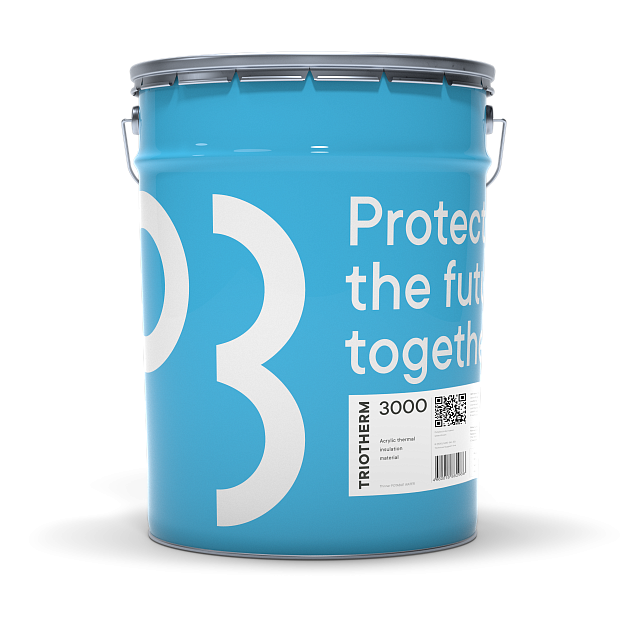
TRIOTERM 3000 — Application Manual
Acrylic Thermal Insulation Material. Product description: see Technical Data Sheet for TRIOTERM 3000.
CONTENT
Instruction gives information on how to prepare the surface; preparation for application; application and equipment; storage; safety; fire prevention measures; environmental protection; first aid measures.
SURFACE PREPARATION
The heat-insulating material is applied to a pre-primed surface. The typical surface preparation process is determined by the condition of the primer surface.
The surface of the primer before applying the heat-insulating material must be clean, free of dirt, dust, homogeneous and even. Impurities should be removed with drinking water under pressure up to 35 MPa, oil and fat contaminants should be removed with a solvent according to GOST 9.402.
If there are damages, defects, chips on the surface of the primer, it is necessary to restore the coating in accordance with the technology approved by the primer manufacturer.
The application of heat-insulating material is carried out on a dry, clean, primed surface after its preparation. The interval between surface preparation and the application of the insulating material is determined by the environmental conditions and the characteristics of the materials used.
In case of direct exposure to precipitation, it is necessary to wait for the surface to dry completely and repeat the procedure for its preparation.
Do not allow the application of heat-insulating material if the period of overlapping the primer is exceeded in accordance with the recommendations of the primer manufacturer. If the overlap interval is exceeded, sweeping (light abrasive blasting, carried out at an angle of 30° to the surface to be cleaned and pressure 1/2 of the working pressure) before applying the heat-insulating material.
Acceptance of the preparation of the primed surface is carried out with the preparation of an act of hidden works.
PREPARATION FOR APPLICATION HEAT-INSULATING MATERIAL
TRIOTERM 3000 is a one-component aqueous acrylic heat-insulating material with a volume fraction of non-volatile substances – (80±5) %.
The heat-insulating material is supplied ready for use in Euro buckets (2, 5, 10, 20 liters).
Before use, the material must be kept for at least 24 hours at a temperature not lower than plus 15 °C and not higher than plus 25 °C. Before application, mix the material to a homogeneous consistency throughout the volume: using mechanical stirring means, at low speeds – from 150 to 300 rpm, for (3–5) minutes. Application should be started immediately after mixing.
APPLICATION HEAT-INSULATING MATERIAL
Application method:
Spatula, brush, roller, airless spraying.
Thinner:
The solvent is water. The amount of dilution depends on the method of application:
- with a spatula – without dilution;
- with a brush with a soft bristle – without dilution;
- roller – with dilution from 25 to 35 % of the weight;
- airless spraying – without dilution or with dilution from 5 to 10 % by weight.
Nozzle Diameter (Recommended):.019″ – .027″. Apply without filters!
Working pressure (recommended):at least 100 bar.
Equipment flushing:Water.
Recommended application conditions:
- is applied in layers at ambient temperatures from plus 10 °C to plus 45 °C;
- relative humidity not higher than 65 %;
- the temperature of the surface to be painted is at least 3 °C above the dew point;
- the absence of direct atmospheric precipitation.
IMPORTANT: It is forbidden to perform work if the above parameters do not meet the required ones.
Parameters control:
Before the start of each work shift and every 4 (four) hours, the following parameters must be checked and recorded in the operational control log:
- environmental conditions (air temperature, relative humidity);
- dew point temperature;
- surface temperature;
- absence of moisture and oil contamination on the surface of the primer prepared for the application of heat-insulating material;
- absence of dust on the surface of the primer prepared for the application of heat-insulating material.
Before starting painting, pass a cleaner through the paint spraying machine to clean the equipment from previously used paints and coatings. The cleaner directly depends on the type of materials previously used. The procedure for cleaning equipment should also be carried out at the end of the shift and during breaks in work for more than 1 hour – with water.
Recommended wet film thicknesses (WFT) per pass depend on the application method:
- with a spatula – 1 mm, without dilution;
- with a brush with a soft bristle – 0.5 – 1 mm, without dilution;
- roller – 0.3 – 0.6 mm, with water dilution from 25 to 35 % of the weight;
- airless spraying – (0.6–1) mm, with dilution with water from 5 to 10 % by weight.
Table of wet and dry film thicknesses of one coating layer:
Drying time:
Drying time with a dry film thickness of TRIOTERM 3000 – (240–800) μm
The drying time is determined by the current DFT. The drying times given in this section are of a recommendatory nature. When estimating the actual drying time, the presence of air currents and relative humidity must also be taken into account.
Wet layer thickness control:
The thickness of the wet layer is controlled by a «comb» on the last tooth touching the coating. Above each tooth of the comb is marked the value of its gap in microns from the «base» teeth (from 0).
When taking measurements, the comb must be installed perpendicular to the plane of the painted surface. After each measurement, the surface of the «comb» in contact with the coating must be thoroughly wiped with a clean rag.
The thickness of the wet layer of the heat-insulating coating must be recorded in the operational control log / work log.
Quality control of the finished heat-insulating coating:
Quality control of the finished heat-insulating coating is carried out according to the following characteristics:
- appearance (there should be no sags, cracking, peeling, etc.) – uniform white coating;
- thickness (the thickness of the coating shall be measured at least ten points per 1 m² of every 10 m² of the surface of the structure to be painted; the arithmetic mean of the results of all measurements shall be taken as the result, and the standard deviation S(X̄) shall not exceed 20 % of the test results).
To measure the thickness of the dry film of coatings, it is recommended to use thickness gauges with a measurement range from 0 to 5000 μm.
STORAGE CONDITIONS
Thermal insulation material TRIOTERM 3000 it is recommended to store in a well-ventilated dry room at a temperature from minus 5 °C to plus 40 °C in a sealed factory package, in a closed room, to avoid direct exposure to UV rays.
The shelf life of TRIOTERM 3000 is 24 months when stored within the specified temperature range. The material should be used within the shelf life recommended by the Manufacturer. The decision to use a material with a shelf life of more than 24 months is made by the commission.
WORK SAFETY
General provisions:
When performing work, the requirements of GOST 12.3.002, GOST 12.3.005, GOST 12.3.016 must be observed.
Hazardous and harmful production factors must be eliminated or reduced to permissible levels.
When organizing and performing painting works, physiologically justified work and rest regimes should be provided.
Personnel requirements:
Persons not younger than 18 years old who have passed:
- occupational safety training – in accordance with GOST 12.0.004, industrial sanitation, fire and electrical safety;
- professional training.
In accordance with the requirements of SNiP 12-03 and SNiP 12-04, officials are responsible for compliance with the requirements of labor protection and industrial safety in the performance of work.
Workers must know:
- hazardous, harmful production factors, harmful substances in the composition of the materials used in the air of the working area and the nature of their effect on the human body;
- instructions on the procedure for performing work and maintaining the workplace;
- instructions on labor protection, fire safety, industrial sanitation;
- rules of personal hygiene;
- rules for the use of personal protective equipment (PPE);
- rules for providing first aid.
Safety requirements for surface preparation and painting:
All works related to the manufacture, testing and use of the material in the premises must be carried out with the operation of general and local supply ventilation in accordance with GOST 12.4.021. Ventilation should ensure the content of harmful substances in the air of the working area that does not exceed the maximum permissible concentrations in accordance with the requirements of GOST 12.1.005, SanPiN 1.2.3685.
Employees engaged in surface degreasing, preparation and application of paints and varnishes must be provided with personal protective equipment:
- protective suits for painting, disposable or reusable. Regardless of the type, a protective suit for painting must have:
- a zipper that runs along the length of the product for easy putting on and taking off;
- elastic bands, they should be available on the wrists, ankles and waist;
- a hood should be sewn and tightened along the contour of the face;
- rubber gloves as per GOST 20010;
- goggles according to GOST 12.4.253, symbol 3 or similar with the same functional purpose;
- filtering respirators with an insulating face part in the form of a half-mask as per GOST 12.4.296 with a combined RPE filter that provides protection simultaneously against gases, vapors and aerosols according to GOST 12.4.235 A3R3 (brown-white), AKhR3 or similar with the same functional purpose.
Storage of organic solvents at the workplace is allowed in hermetically sealed containers in an amount of no more than two shifts.
When working with solvents, observe the following safety requirements:
- use respiratory and eye PPE;
- work with the ventilation system turned on, which provides air exchange of the required multiplicity.
When preparing the surface, the sandblaster must work in overalls made of dust-proof fabric and a helmet of the MIOT-49 type, use PRB-5, RPM-62 respirators with forced air supply.
Rules for handling toxic substances:
TRIOTERM 3000 is produced in accordance with TC 20.30.11-130-40141638-2018 and is recommended for use both independently and as part of coating systems, as well as combined structural fire protection systems.
Containers of TRIOTERM 3000 heat-insulating material must have a label with the exact name and designation of the material contained therein. Containers must be intact and have a tight-fitting lid.
In case of accidental spillage of material, cover the spillage with sawdust or sand. Collect contaminated solvents, sawdust, sand, rags in buckets and remove them to specially designated places in accordance with the requirements of GOST 30772, GOST 30773, GOST 30774, GOST R 52107.
Eating and smoking are allowed only in specially designated places.
FIRE PREVENTION MEASURES
Fire prevention measures during painting work must be carried out in accordance with the Technical Regulations on Fire Safety Requirements (dated July 22, 2008 No. 123-FZ) and other regulatory documents.
TRIOTERM 3000 is not a flammable material.
When preparing the surface for painting and painting works, it is not allowed:
- smoke, make fire, conduct welding work within a radius of 25 m from the place of work, as well as vertically in this area;
- to heat production premises and protected facilities with electrical appliances in the usual design.
In the event of a fire, it is necessary to take people out of the danger zone, report the fire to the fire service, remove paints and coatings from the working area, and start extinguishing the fire with the available means in strict accordance with the approved plan.
ENVIRONMENT PROTECTION
In the process of painting works, solid and liquid wastes are generated, as shown in Table 1.
Table 1
MEASURES TO PROVIDE FIRST AID
General:
If poisoning is suspected, it is necessary to seek medical help.
By inhalation:
If the product is inhaled, the victim must be taken out into the fresh air, provided with rest and seek medical help.
In case of contact with eyes:
In case of contact with the eyes, rinse them with plenty of clean running water and seek medical attention.
In case of skin contact:
In case of contact with the skin, it is necessary to remove contaminated clothing and thoroughly wash the place of contact with soap and water. Do not use solvents or thinners.
In case of ingestion with food:
In case of ingestion of the product with food, provide the victim with rest and immediately seek medical help.
IMPORTANT: Do not induce vomiting.