

TRIOCOR™ TOP PRIMER 2100. Quick-drying primer-enamel
- Fast drying: to recoat – 1 hour at 20°C
- For corrosion protection of metal structures and concrete surfaces equipment operated in the conditions of atmospheric corrosive activity varying from very low C1 to high C4 (ISO 12944-2).
- It can be applied as an independent coating, as well as in coating systems as an enamel with appropriate compatible primer coatings
- It can be applied on surfaces with wider preparation tolerances (permissible degrees - Sa 2, St 2)
- Availability of a wide range of colors (according to RAL)
TRIOCOR TOP PRIMER 2100 — Technical Data Sheet
Quick-drying primer-enamel. One-pack quick-drying primer-enamel based on synthetic film forming substance.
DESCRIPTION
A one-pack quick-drying primer-enamel based on synthetic film forming substance.
TDS 2613/238 — Revised: April 2021.
TYPE AND RECOMMENDED USE
Primer-enamel is used for corrosion protection of metal structures, concrete structures, communications and equipment operated in moderate, moderately cold and cold climates and atmospheric corrosion activity from very low C1 to high C4 (ISO 12944-2). Primer-enamel is tolerant to surface preparation (the degree of preparation Sa 2, St 2 is allowed). It is applied and cured at temperatures from minus 25 °C. It can be used as a repair material, compatible with most types of old paint coatings. The operating temperature of the coating is from minus 60 °C to plus 40 °C.
PHYSICAL CONSTANTS
FILM THICKNESS
Wet and dry film thickness table
| Film thickness | WFT, microns | DFT, microns |
|---|---|---|
| Minimum | 120 | 50 |
| Maximum | 190 | 80 |
| Recommended | 143 | 60 |
DRYING TIMES
Drying times at DFT of 60 microns
| Temperature of environment | −25 °C | −20 °C | −10 °C | 0 °C | 5 °C | 10 °C | 20 °C | 30 °C |
|---|---|---|---|---|---|---|---|---|
| To recoat | 48 h | 36 h | 18 h | 9 h | 6 h | 2 h | 1 h | 30 min |
The maximum recoating interval is unlimited.
The drying time of the coating at a temperature of (20±2) °C before transportation is possible is at least 12 hours.
The time of complete curing of the coating at a temperature of (20±2) °C is at least 7 days.
The drying time is determined by the layer thickness actually applied. The drying time values given in this section are of a recommendatory nature. When assessing the actual values of the drying time, it is also necessary to take into account the presence of air flows and relative humidity.
SURFACE PREPARATION
The material is applied to a pre-prepared surface.
Steel surface: The surface to be painted must be dry, clean and uniform with a temperature at least 3 °C above the dew point. A typical surface preparation scheme includes the elimination of metal surface defects to the degree of P2 according to ISO 8501-3 (at the same time, sharp edges and corners must be rounded with a radius of at least 2 mm), abrasive blasting to the degree of Sa 2 according to ISO 8501-1 (local application of cleaning by hand or mechanical tools to the degree of St 2 is allowed), degreasing to the degree of 1 according to GOST 9.402, desalination (if necessary), roughness assessment (must correspond to the average (G) profile according to ISO 8503-1) and dedusting with compressed air of group 2 according to GOST 9.010 to a degree of no more than 2 with a particle size of no more than class 2 (according to ISO 8502-3).
Concrete surface: the surface to be painted must be dry, solid, durable, have no cracks, potholes, protruding fittings, sinks, surges, have the required roughness class, must be free from contamination – cement milk, dirt, dust, oil contamination.
Old compatible coatings: must be dry, free of foreign inclusions, dust, dirt, and have the appropriate roughness. A more detailed description of the preparation of surfaces of various types is given in the instructions for applying primer enamel.
APPLICATION DETAILS
Material preparation:
The material is one-pack, before application it is required to mix thoroughly for 5–7 minutes until a homogeneous state.
Application method:
Airless spraying / Pneumatic spraying / Manual application.
Thinner:
TRIOSOLV 0002. Make the dilution in increments of 1 vol. %. The recommended dilution value is:
- For airless spraying – (0–5) vol. %;
- For pneumatic spraying – (0–15) vol. %;
- For application with a brush or roller (strip painting, complex shape products, areas up to 1 m²) – (0–5) vol. %.
Nozzle size (recommended):
- For airless spraying – .013″ – .019″;
- For pneumatic spraying – (1.5–2.0) mm.
Operating pressure (recommended):
- For airless spraying – (150–180) bar;
- For pneumatic spraying – (2.0–3.5) bar.
Cleaning of tools:
TRIOSOLV 0002.
Application conditions:
- Air temperature from minus 25 °C to plus 30 °C;
- Relative humidity no more than 80 %;
- Prepared surface should be dry, its temperature should be at least 3 °C above the dew point.
(In closed rooms it is necessary to provide supply-and-exhaust ventilation during application and drying to the extent necessary).
RECOMMENDED SYSTEMS
It is used as an independent coating, and also as an enamel for alkyd, alkyd-modified and acrylic primer layers, as well as compatible coatings of other types. For detailed information, contact «O3-Coatings».
STORAGE
12 months from the date of manufacturing. Product should be stored in dry, dark space at temperatures between minus 40 °C to plus 40 °C in the original sealed packaging, away from heat and ignition sources, avoiding direct exposure to UV-rays and ingress of moisture.
ADDITIONAL NOTE
Small deviations of numerical values of physical quantities are acceptable.
PACKAGE
Container (net weight 20 kg).
HEALTH AND SAFETY
Refer to the Safety Data Sheet before use.
TRIOCOR TOP PRIMER 2100 — Application Manual
Fast-Drying Primer-Enamel. Product description: see Technical Data Sheet for TRIOCOR TOP PRIMER 2100.
CONTENTS
The Manual describes the surface preparation; the product preparation for the application; technical application process and equipment; storage conditions; occupational safety; fire precaution measures; environmental protection; first aid measures.
SURFACE PREPARATION
The material can be applied to steel, concrete surfaces and old compatible coatings.
- The product is applied to a prepared and dry metal surface with a temperature at least 3 °C above the dew point. Typical process includes the elimination of metal surface defects to P2 according to ISO 8501-3 (while sharp edges and corners must be rounded with a radius of at least 2 mm), abrasive blasting to Sa 2 according to ISO 8501-1 (local use of cleaning with a hand or mechanical tool to degree St 2 is allowed), degreasing to degree 1 according to GOST 9.402 (using drinking water, aqueous solutions of surfactants (followed by thorough rinsing with drinking water) or solvents), desalination (if necessary), roughness assessment (must correspond to the average (G) profile according to ISO 8503-1) and dust removal with compressed air of group 2 according to GOST 9.010 to degree no more than 2 with a particle size of no more than class 2 (according to ISO 8502-3).
- When applied to concrete surfaces: the surface to be painted must be dry, hard, durable, free of cracks, potholes, protruding reinforcement, cavities, burrs, have the required roughness class, must be cleaned of contaminants – cement laitance, dirt, dust, oil contaminants. Defective areas must be repaired. The roughness class must meet the following requirements:
Distance between protrusions and depressions, mm Basic length of size, mm Total area of individual sinks and depressions per 1 m², %, with a sink depth of up to 2 mm 0.6–1.2 100 Up to 0.2 Surface moisture of concrete (at a depth of 20 mm) – no more than 4 % by weight.
pH of concrete surface – no less than 7.
- When applying to old coatings: the coating surface must be dry, free of foreign inclusions, dust, dirt, and have the appropriate roughness. If the surface of the previous layer has damage, defects, or chips, it must be restored in accordance with the technology approved by the manufacturer of the applied material.
Do not apply the material if the coating overlap period (previous layer) established by the manufacturer of the applied material has been exceeded. If the overlap interval is exceeded, then to ensure interlayer adhesion, before applying the material, it is necessary to roughen the coating surface by sweeping (light abrasive blasting, performed at an angle of 30° to the cleaned surface and a pressure of ½ of the working pressure) followed by dust removal with compressed air of group 2 according to GOST 9.010 to a degree of no more than 2 with a particle size of no more than class 2 (according to ISO 8502-3).
PREPARATION FOR THE APPLICATION
Primer-enamel is a single-pack material based on a synthetic film former.
The product is supplied in containers – 20 kg.
After opening the container, before application, the material must be thoroughly mixed for 5–7 minutes.
APPLICATION
Application method:
Airless spraying / Manual application.
Thinner:
Thinner TRIOSOLV 0002. Dilute in 1 % vol. increments.
The recommended dilution rate is:
- when applying by airless spraying – (0–5) % vol.;
- when applying by pneumatic spraying – (0–15) % vol.;
- when applying by brush or roller (strip painting, complex-shaped items, areas up to 1 m²) – (0–5) % vol.
For detailed information, contact «O3-Coatings».
Nozzle size (recommended):
- When applied by airless spray – .013″–.019″;
- When applied by air spray – (1.5–2.0) mm.
Working pressure (recommended):
- When applied by airless spray – (150–180) bar;
- When applied by pneumatic spray – (2.0–3.5) bar.
Cleaning of tools:
TRIOSOLV 0002.
Application conditions:
- Air temperature from minus 25 to plus 30 °C;
- Relative humidity no more than 80 %;
- Temperature of the paintable surface is as minimum 3 °C above the dew point.
(In closed rooms it is necessary to provide supply-and-exhaust ventilation during application and drying to the extent necessary).
Parameters control:
Before the beginning of each working shift and every 4 (four) hours the following parameters must be checked and documented in the operations log:
- environmental conditions (air temperature, relative humidity);
- dew point temperature;
- surface temperature;
- absence of moisture and oil contamination on the surface;
- absence of dust on the surface.
Before the application, use a thinner to clean the painting sprayer from previously used paint materials. The choice of the thinner directly depends on the type of the previously used materials. The equipment cleaning procedure must be also conducted at the end of each working shift.
When applied by airless spray, the recommended wet film thickness (WFT) per pass is 143 μm, which corresponds to a dry film thickness (DFT) of 60 μm.
Table 1 — Recommended thickness of one coat for TRIOCOR TOP PRIMER 2100:
| Film thickness | WFT, microns | DFT, microns |
|---|---|---|
| Minimum | 120 | 50 |
| Maximum | 190 | 80 |
| Recommended | 143 | 60 |
Table 2 — TRIOCOR TOP PRIMER 2100 drying time at DFT 60 microns:
| Surface temperature | −25 °C | −20 °C | −10 °C | 0 °C | 5 °C | 10 °C | 20 °C | 30 °C |
|---|---|---|---|---|---|---|---|---|
| Recoating time | 48 h | 36 h | 18 h | 9 h | 6 h | 2 h | 1 h | 30 min |
The maximum overlap interval is not limited.
Drying time of the coating at a temperature of plus (20±2) °C before transportation is possible is not less than 12 hours.
Full curing time of the coating at a temperature of plus (20±2) °C is not less than 7 days.
Drying times presented in this section have recommendatory character. It is necessary to take into account the presence of air flows and relative humidity when assessing actual drying time.
Wet film thickness control:
The wet film thickness control is determined by the last notch of a wet film thickness gauge that touched the film surface. Above each notch of the gauge the difference between its length and the length of the outside base notches (zero datum reference) is indicated.
When conducting measurements, the gauge should be set perpendicular to the coated surface. After each measurement, the parts of the gauge that were in contact with the coat must be carefully wiped with a clean cloth.
Wet film thicknesses of the coating must be recorded.
Quality control of the finished coating:
The quality control of the finished coating is done using the following characteristics:
- appearance (no sagging, cracking, peeling, etc.) – uniform, grey-colored coating;
- dry film thickness is determined by the 80–20 rule:
- 80 % of all measurements must not be below the thickness given in a specification (nominal thickness);
- 20 % of the measurements must be at least 80 % of the nominal thickness.
To measure the thickness of a dry coating, it is recommended to use electromagnetic protective coating thickness gauges.
STORAGE CONDITIONS
Primer-enamel TRIOCOR TOP PRIMER 2100 should be stored in dry, dark space at temperatures between minus 40 to plus 40 °C in the original sealed packaging, avoiding direct exposure to UV-rays and other sources of heat.
Shelf life TRIOCOR TOP PRIMER 2100 is 12 months from date of manufacture. The material should be used within the manufacturer’s recommended expiration date.
OCCUPATIONAL SAFETY
General rules:
Works is carried out in accordance with the requirements of GOST 12.3.002, GOST 12.3.005, GOST R 12.3.052, order of December 2, 2020 No. 849n «On approval of the Rules for labor protection when performing painting works».
Occupational hazards and harmful should be eliminated or reduced to acceptable levels.
When organizing and carrying out painting works, a physiologically justified work-rest schedule should be provided.
Qualification requirements:
The application of the corrosion resistant coating can be conducted only by adults who are at least 18 years old that have undertaken:
- safety training in accordance with Resolution of the Russia Federation № 2464 of 24.12.2021, including occupational hygiene, fire and electrical safety;
- professional training.
The executive officers are held responsible for complying with the occupational and industrial safety requirements when conducting the application works, in accordance with the requirements of SNiP 12-03 and SNiP 12-04.
Workers must know about:
- hazards, harmful occupational factors, harmful substances in the materials that affect the air in the workplace and how they can affect the human body;
- application instructions and procedures, and requirements for the workplace maintenance;
- workplace safety guidelines, fire safety, industrial health;
- personal hygiene requirements;
- requirements for using personal protective equipment (PPE);
- first aid procedures.
Safety requirements for preparing and painting surfaces:
For any work related to the application of coatings in confined spaces, the general supply-exhaust ventilation and local exhaust ventilation are a prerequisite in accordance with GOST 12.4.021. The ventilation must ensure that the content of harmful substances in the air of the workplace does not exceed the maximum allowable concentrations, in accordance with the requirements of GOST 12.1.005, SanPiN 1.2.3685.
Workers engaged in degreasing the surface, preparing and applying paintwork materials should be provided with the following personal protective equipment:
- disposable or reusable protective suit for painting which has zipper runs for length of the product, elastics at wrists, ankles and at the waist, and hood;
- rubber technical gloves according to GOST 20010;
- safety glasses according to GOST 12.4.253 (EN 166:2002), symbol 3 or similar which has similar functional purpose;
- filter respirators which have isolating front part in form of half-mask according to GOST 12.4.296 equipped with combined filter, which provides the protection from gases, vapors and aerosols according to GOST 12.4.235 A3P3 (brown-white), AHP3 or similar which has similar functional purpose;
- shoes made from leather which has solid toes to avoid the injury of feet in case of the fall of a heavy object; sole must be protected with the metal plate.
Storage of organic thinners in the workplace is permitted in hermetically sealed containers in amounts that don’t exceed two working shift doses.
When working with thinners observe the following safety requirements:
- use PPE for respiratory and eye protection;
- work with the activated ventilation system that ensures sufficient air exchange.
When preparing the surface, workers conducting abrasive blasting must wear protective suits made from dust-proof material and helmets MIOT-49 type, use respirators PRB-5 with forced air supply.
Requirements for handling toxic substances:
Material TRIOCOR TOP PRIMER 2100 is produced in accordance with TU 20.30.22-237-40141638-2021 and is used to protect against corrosion of metal structures, concrete structures, communications and equipment operating in conditions of moderate, moderately cold and cold climates and atmospheric corrosive activity from very low C1 to high C4 (ISO 12944-2).
The packaging of material TRIOCOR TOP PRIMER 2100 must have a label with the exact name and designation of the product that it contains. Containers must be whole and have a tight-fitting lid.
In a case of an accidental spill, the spill area must be covered with sawdust or sand after ensuring respiratory protection. Contaminated thinners, sawdust, sand, rags, cloths must be collected in pails and removed to specially designated areas in accordance with the requirements of GOST 30772, GOST R 52107.
Eating and smoking are only allowed in designated areas.
FIRE PRECAUTION MEASURES
Fire precaution measures during coating application works must be carried out in accordance with the technical regulations related to fire safety requirements (July 22, 2008 № 123-FZ) and other regulatory documents.
The coating materials are considered to be fire-hazardous, therefore, fire precaution measures in accordance with GOST 12.1.004 and Resolution of the Russia Federation № 1479 of 16.09.2020 «Rules of the Fire Fighting Regime in the Russian Federation» are carried out at the workplace.
When preparing the surface for coating application and when applying coating, it is prohibited:
- to smoke, make a fire, conduct welding within a radius of 25 m from the workplace and along the vertical line below and above the area;
- to heat the production facilities and protected objects with electrical appliances in a conventional way.
In the event of a fire, evacuate all people from the area, report the fire to the fire service, remove coating materials from the workplace, and proceed to extinguish the fire with the available means in strict accordance with the approved plan.
ENVIRONMENTAL PROTECTION
Coating application produces solid and liquid waste described in Table 3.
Table 3
| Type of waste | Method of waste management |
|---|---|
| Solid waste: Packaging of the product – Containers | The packaging can be disposed of as domestic waste. Containers can be reused for technical purposes after the product remaining on the inner walls of the container has dried. |
| Liquid waste: 1. Thinner / flushing liquid for cleaning the painting sprayer 2. Remains of the product | The waste is disposed of by the product user in accordance with GOST 30772, GOST R 52107 |
FIRST AID MEASURES
General information:
In the case of a suspected poisoning, seek medical help.
After inhalation:
In the case of inhalation of the product, take the affected person to fresh air, keep them at rest and seek medical help.
After eye contact:
In the case of an eye contact with the product, flush the eyes with a lot of clean running water and seek medical help.
After skin contact:
In the case of skin contact, remove contaminated clothes and thoroughly clean the area of contact with soap and water. Do not use thinners or diluents.
After swallowing:
In case of swallowing, keep the affected person at rest and immediately seek medical help.
You may also be interested in

TRIOTEMP™ 600. High-temperature coating
Silicone-acrylic coating
Application temperature : +5°С / +30°С
Color : Aluminum

TRIOCOR™ BETON 4700. Enamel primer
One-component fast-drying anticorrosive material based on an organic solution of a complex synthetic film-forming agent.
Application temperature : -30°C / +30°C
Color : RAL color matching
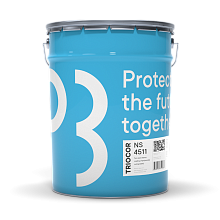
TRIOCOR™ NS 4511. Epoxy coating
Two-component epoxy coating of polyamide curing with high molecular weight.
Application temperature : -10°С / +35°С
Color : Gray

Any questions?
Please contact us.